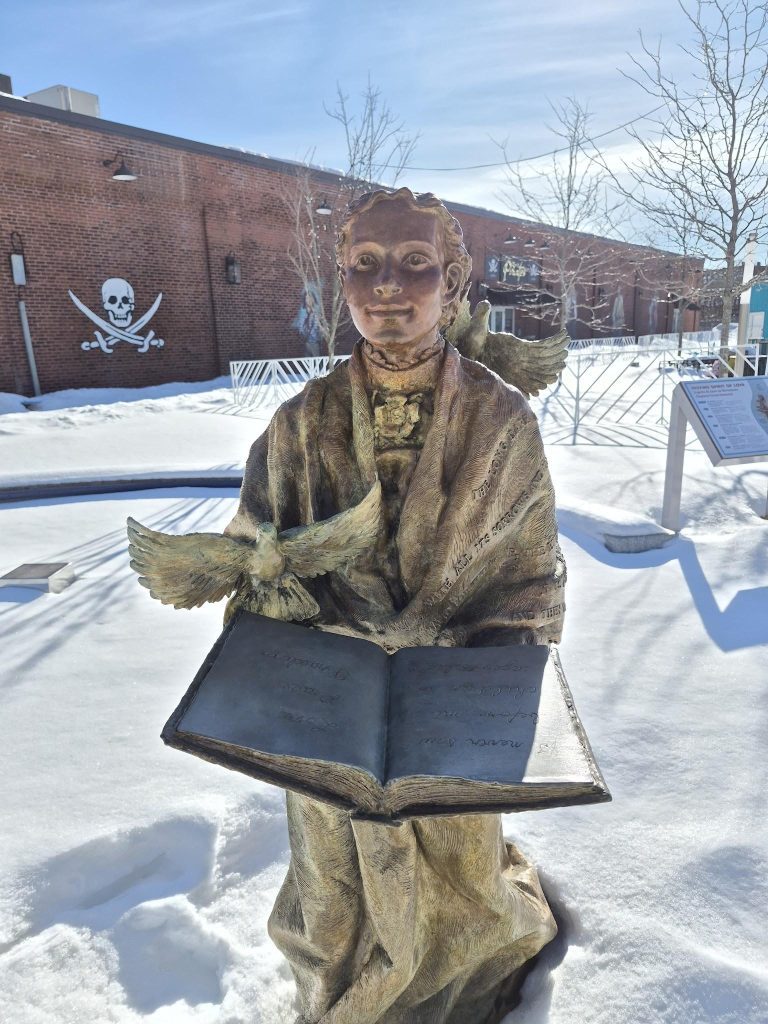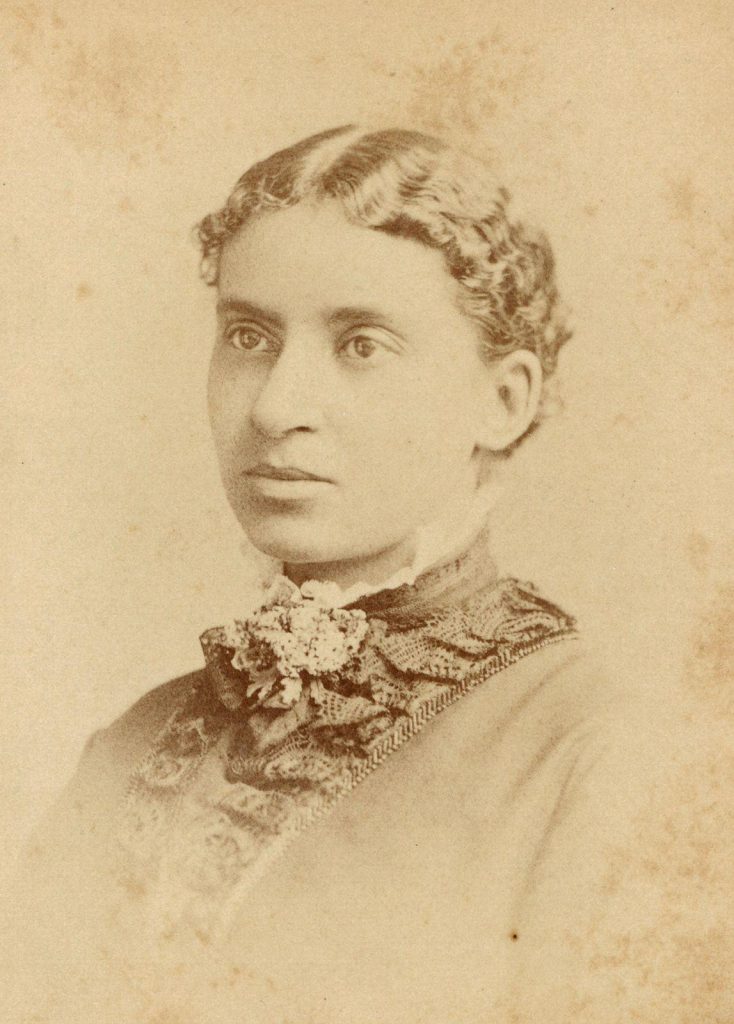
“White Stone Days”: Charlotte Forten Grimké’s Time in Salem
by Anna Ruane
The City of Salem was home to a fair share of notable figures-Roger Conant, Elias Hasket Derby, Sarah Parker Remond, Nathaniel Hawthorne, and, for this month, we are highlighting another legend-Charlotte Forten Grimké. Daughter of Robert Bridges Forten and Mary Virginia Wood Forten, Charlotte was born August 17, 1837, in Philadelphia, PA. She came from an affluent family and a long line of abolitionists. Charlotte’s grandfather, James Forten, earned his wealth working as a sailmaker after serving in the Revolutionary War, a trade which his son Robert would take up as well. The two men would continue working side-by-side after hours as well. Both were active abolitionists in the Philadelphia region.
While Pennsylvania was one of the earliest states to outlaw slavery, on the eve of the Civil War, it was still heavily segregated. For most of her schooling, Charlotte was privately educated. In 1854, at 17, Charlotte was sent to Salem, Massachusetts, to complete her education at a non-segregated, public school. Her father helped secure her housing with the Remonds, an African American family of social activists from Salem. Several members of the family traveled throughout the United States and Europe by the mid-19th century, giving speeches on abolition and women’s rights. While living with the Remonds, Charlotte attended Higginson Grammar School and, in 1854, was the only black student. Much of Charlotte’s studies focused on history, geography, drawing, and literature. In her diary, she describes studying Nathaniel Hawthorne’s Twice Told Tales and Tanglewood Tales, both of which contain collections of short stories.
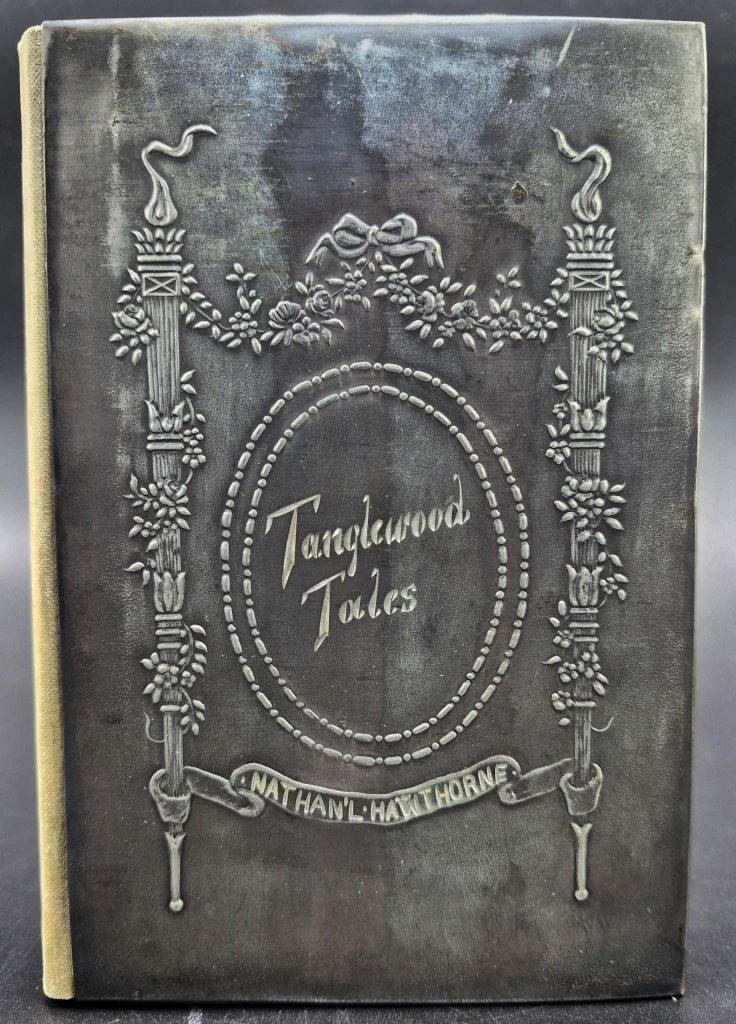
Tanglewood Tales
Hawthorne, Nathaniel. Springfield, MA: The Merriam Company. The House of the Seven Gables Hawthorne Family Collection
The above copy of Tanglewood Tales features a sleek metal cover with the book title etched inside an elegant oval frame. On either side are embossed torches wrapped in vines, standing tall like columns. At the top, the torches are joined together by the vines intersecting in the middle with a small bow. Towards the base of the torches, an embossed banner features the author’s name (Nathan’l Hawthorne) etched in capital letters. The book retells Greek myths with accompanying illustrations.
While Charlotte and Nathaniel themselves would never meet, they did operate within the same circles. Charlotte eventually met Ralph Waldo Emerson and Jones Very, who were friends of Hawthorne. Charlotte also had the chance to meet Nathaniel Hawthorne’s sister, Elizabeth. On a sunny July day, Elizabeth sat with Charlotte, showing the young woman several personal belongings, including two portraits of Nathaniel Hawthorne.
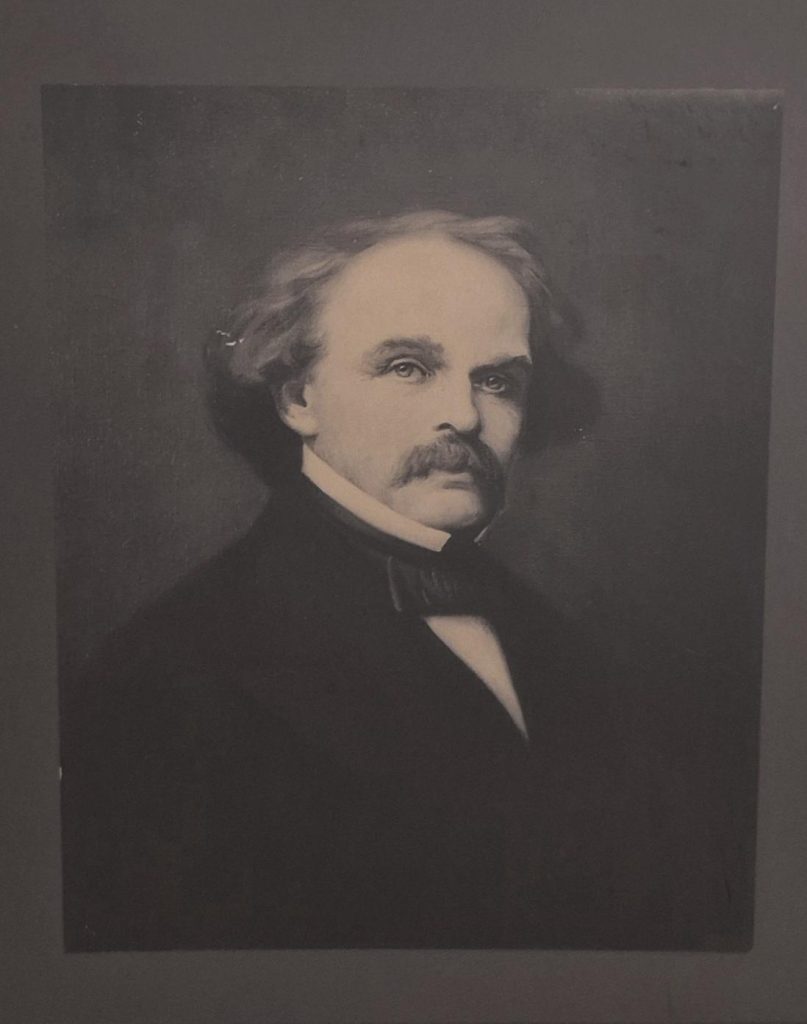
Nathaniel Hawthorne
Unknown Artist, Nathaniel Hawthorne Photogravure. The House of the Seven Gables.
While we really do not know which portraits of Hawthorne Charlotte saw, The Gables has many prints and portraits of Hawthorne. This one was replicated from a portrait of him done in 1860, just six years after Elizabeth shared the portrait of him with Charlotte. In this print, an older, mustached Hawthorne sits facing right, and is wearing a white collared shirt of the period, with a matching black coat and vest. His large bowtie brings the look together. The author’s dark brows contrast with his light-colored eyes, which are peering off into the distance.
Charlotte herself was quite surprised at the author’s appearance, expecting to see a moody, gloomy-looking figure. Instead, Charlotte was “agreeably disappointed. Grave, earnest, thoughtful, but not gloomy” (The Journal of Charlotte Forten, July 10, 1854, pp. 54). The next portrait Elizabeth produced was of a much younger Nathaniel. Both portraits, as described by Charlotte, captured Hawthorne’s genius. Yet, in the earlier image of Hawthorne, she notices his carefree appearance.
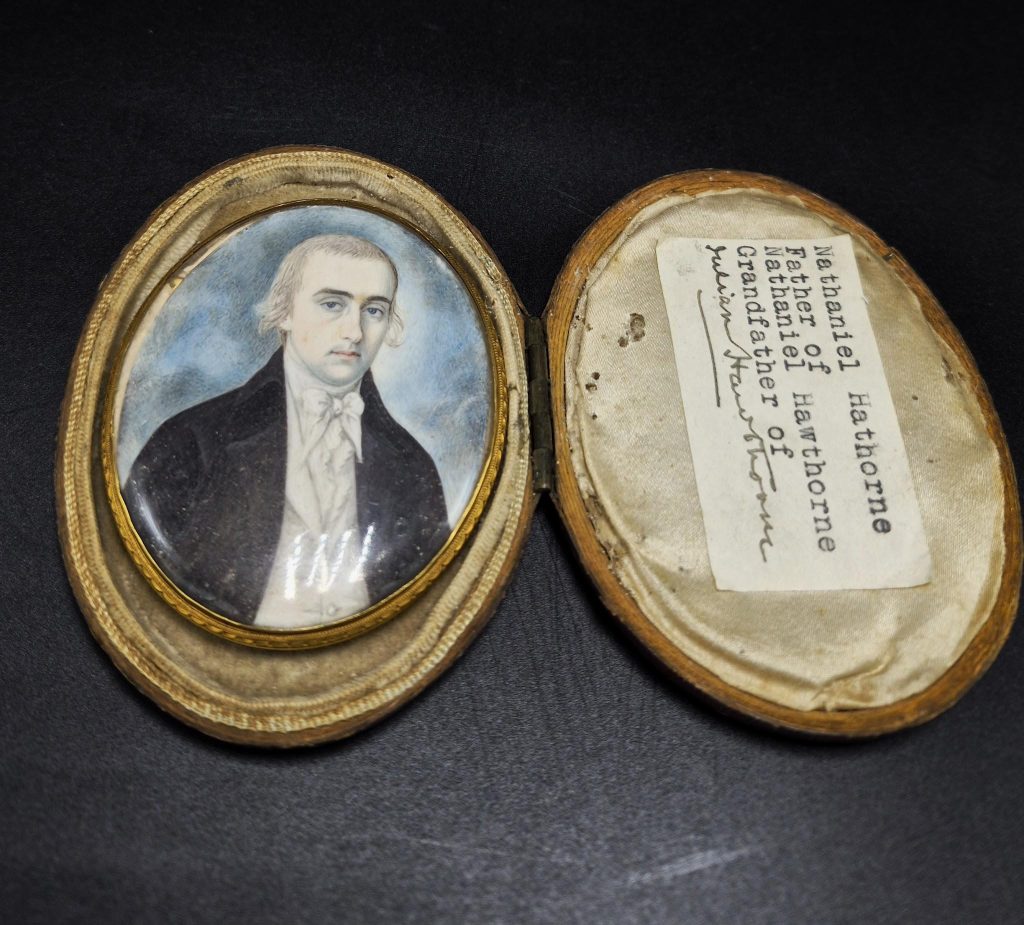
Captain Nathaniel Hathorne
Unknown Artist, circa 1795. Captain Nathaniel Hathorne. Watercolor on Ivory. The House of the Seven Gables Hawthorne Family Collection
A shy Hawthorne rarely had his image taken, and with so few original portraits remaining, most are referred to by the pose Nathaniel is positioned in. While at Bowdoin, he even refused to have his paper-cut silhouette made for his class portrait, though he eventually complied. It must have been truly special to Elizabeth to have two images of her brother. When it comes to early images of Hawthorne in The Gables collection, we have no miniature portraits of the author as his sister did, but we do have a miniature of their father. In this portrait, Nathaniel Hathorne, much like Charlotte’s description of his son, has a youthful, almost carefree look to him. He wears a white shirt, vest, and bowtie, along with a dark coat. His hair, either a wig or powdered, is nearly just as white as his shirt. The younger Nathaniel, Captain Hathorne’s son and namesake, remarkably resembles his father-both men have a high forehead, deep-set blue eyes, and fair complexions. Eventually, the author would add a ‘w’ to his last name, going from Nathaniel Hathorne to Nathaniel Hawthorne. It is assumed that the change was to separate himself from his Puritan ancestors, but it is also possible that the change was for the sake of pronunciation. Regardless, his mother and two younger sisters followed suit, signing their letters with the last name as Hawthorne.
Nearly two weeks after their first meeting, Elizabeth and Charlotte met again. A nature lover, Elizabeth would occasionally join students and teachers on walks along local beaches. On a warm summer day, Elizabeth and a few students, including Charlotte, sought to escape the heat and enjoy their day by traveling to one of the beaches in Marblehead. While walking along the water to collect rocks and seaweed, Elizabeth handed Charlotte a round, white stone to remember the place. This gesture obviously stayed with Charlotte, as, throughout the rest of her life, she referred to memorable moments as “white stone days.”
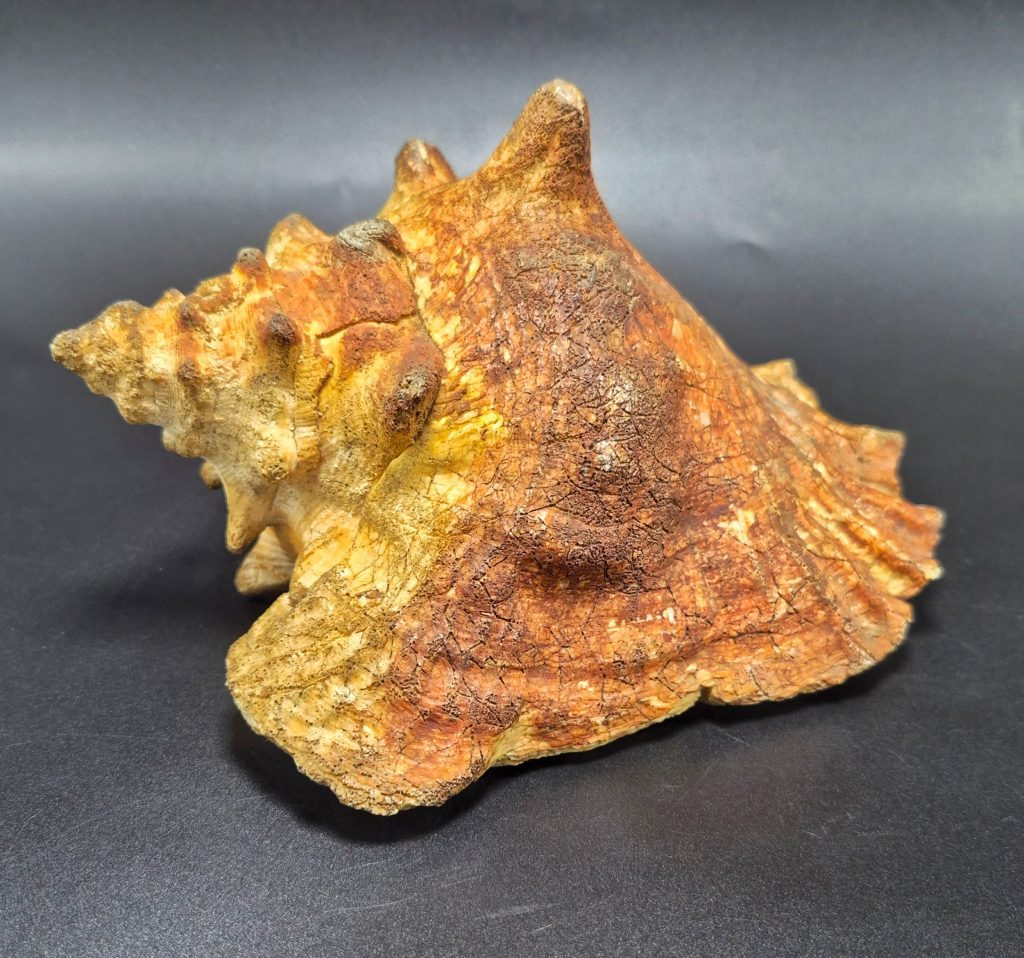
Conch Shell with Applied Red Paint
Owned by Elizabeth Manning Hawthorne, circa 1820. The House of the Seven Gables Hawthorne Family Collection.
Following the trends of her time, Elizabeth Hawthorne collected many natural history specimens, ranging from flowers to shells. The 19th-century introduced an obsession with the natural world; it became common for trading companies to bring back various tropical items for collectors. Dating back to 1820, Elizabeth’s shell was painted red at one point. Two holes drilled into the massive shell tell us that it was hung as a decoration.
In her journal, Charlotte describes other memorable “white stone days,” labeling the day she met John Greenleaf Whittier (1807-1892) in person as one of those moments. It had been several years since Elizabeth handed her the stone, and Charlotte was no longer a student but a teacher. After graduating from Salem Normal School (now Salem State University), Charlotte began teaching at Epes Grammar School in Salem and wrote poems and essays, which were published in newsletters and journals (something Charlotte had begun while a student). Whittier, an abolitionist and poet himself, would become Charlotte’s mentor and publisher, with the two only communicating through letters.
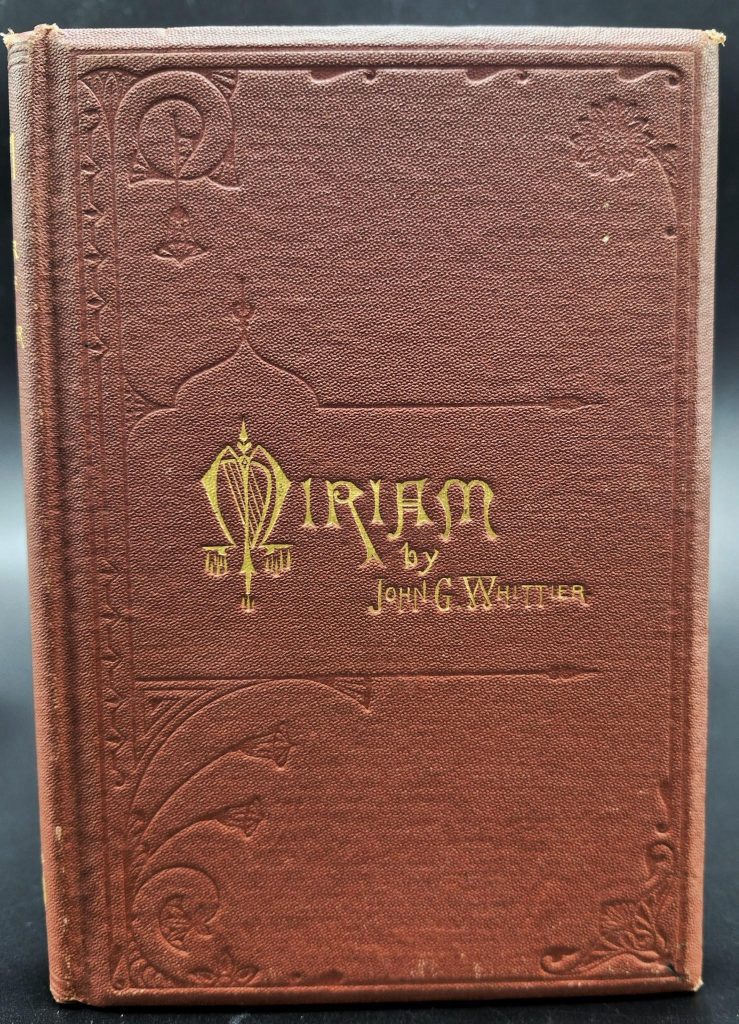
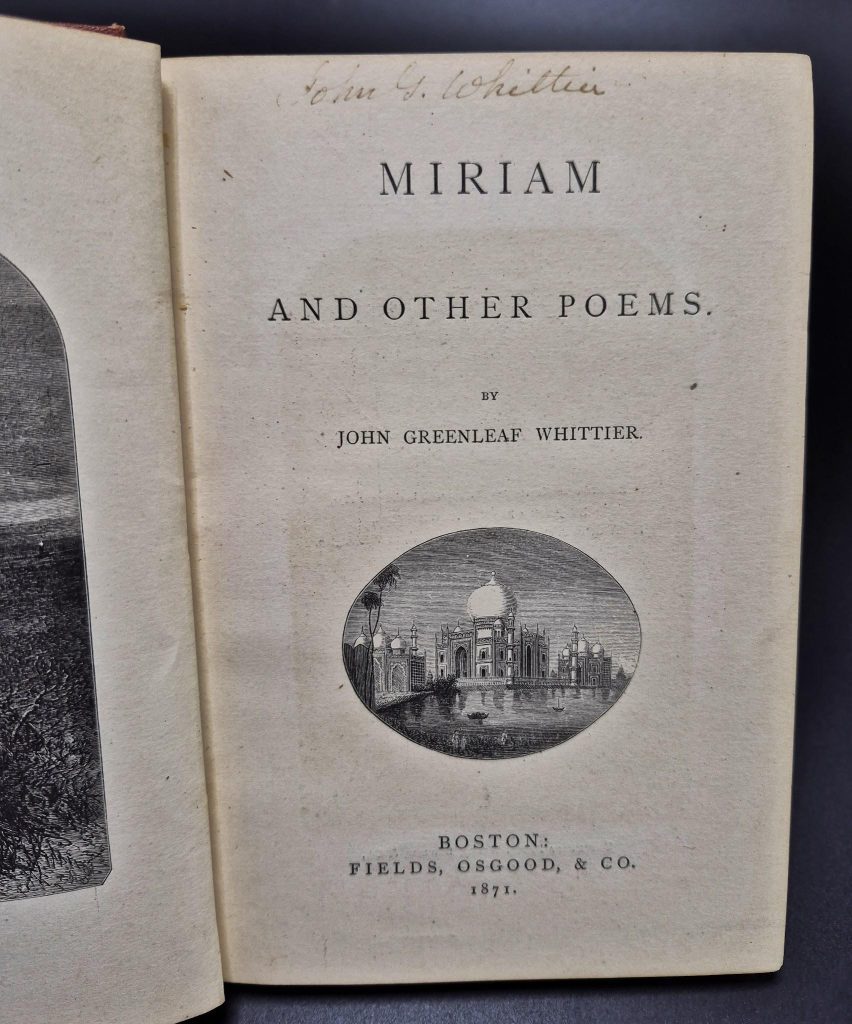
Miriam and Other Poems
Whittier, John Greenleaf. 1871. Boston: Fields, Osgood, & Co. The House of the Seven Gables.
Whittier, born in Haverhill, MA, was well acquainted with the Forten family before he and Charlotte began communicating. In 1833, Whittier produced the poem “To the Daughters of James Forten,” a tribute to the aunts of Charlotte, who at the time were all involved with Philadelphia’s Female Anti-Slavery Society. Charlotte, too, would become an active member of an Anti-Slavery Society in Salem. The above collection of Whittier’s poetry, Miriam and Other Poems, was published in 1871 by Fields, Osgood, and Company. This edition has an embossed orange cover with floral patterns framing the center title and author’s name. The gilded text appears in a Gothic font, reading “Miriam by John G. Whittier.” On the interior title page, the author’s signature is visible at the very top. Charlotte and Whittier’s meetings brought forth discussions on social issues, abolition, and literature.
In April, 1861, the American Civil War broke out. Victories on the Union’s side brought greater opportunities for formerly enslaved black Americans. In November 1861, the Union was victorious in the Battle of Port Royal, resulting in the end of enslavement for over ten thousand people and the launch of the “Port Royal Experiment,” in which the government enlisted freed men to purchase land for their own profit, provided medical care, and put out a call for educators. Charlotte would become one of the teachers to answer the call. With a letter of recommendation from Whittier in hand, Charlotte made her way to the Penn School on St. Helena Island. Charlotte would continue to teach throughout the rest of her life, going on to live in Washington, D.C. (where she would meet her future husband, Reverend Francis Grimké) and Florida. The couple would return to Washington, D.C. and remained there until Charlotte’s death in 1914.
Interested in learning more about Women’s History at The Gables? Join us for our free Women’s History Tour! This 45-minute long experience focuses on the many women who have lived and labored on the property. Tours are available in English on Saturdays and Spanish on Sundays every weekend in March. For more information, visit 7Gables.org/events
Want to see what else our collection has to offer? Visit our Online Collections catalog here!