The Closet, the Secret Staircase, and the Hidden Hearth
By Timothy Orwig, Boston College and UMass Lowell
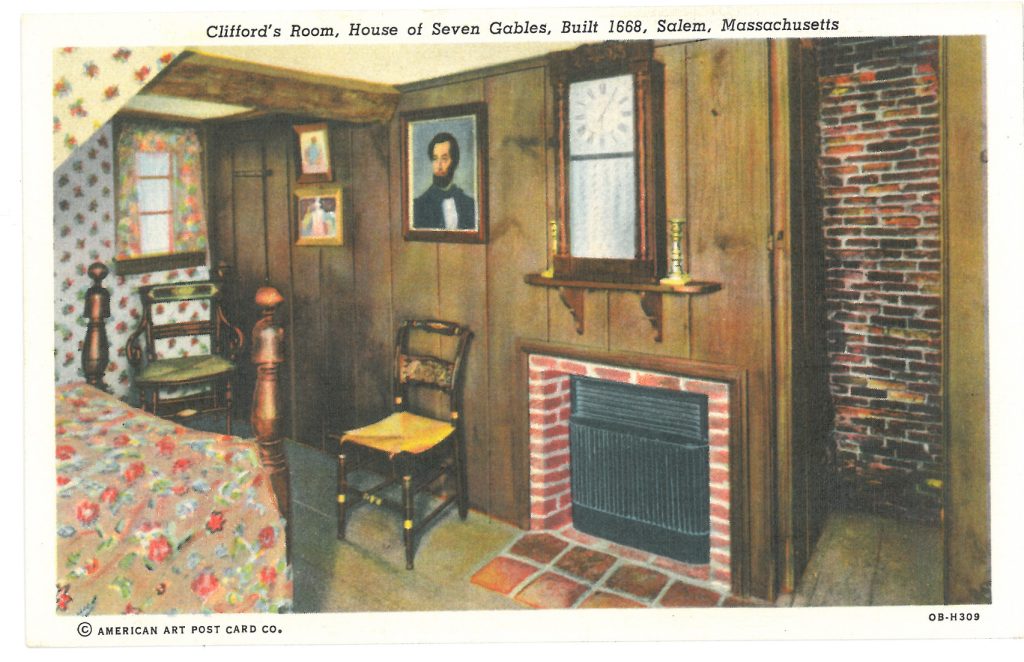
Open a closet door in The House of the Seven Gables, and you encounter the Secret Staircase, leading to a seemingly hidden bedroom. Beloved by visitors since the house opened for tours in 1910, this secret passage conveys the intrigue and mystery of Nathaniel Hawthorne’s novel, as well as the ancient house, which is its title character. It takes us from our conventional world into a Gothic romance of fear, discovery, and redemption. Might it also take us into the hidden lives of queer Bostonians?
Philanthropist Caroline Emmerton hired architect Joseph Everett Chandler to restore the 1668 Turner-Ingersoll mansion in Salem. Made famous by Hawthorne as the inspiration for his 1851 novel, the house shows the power of historic preservation. As the stage for Emmerton’s settlement house, it taught immigrants the importance of American culture, housed workers, and brought in a steady stream of tourists to pay the bills.
The themes of Hawthorne’s Gothic romance are rumors, guilt, hidden identities, and the corrosive effect of family secrets: “The wrong-doing of one generation lives into the successive ones, and…becomes a pure and uncontrollable mischief.” The House represents the Pyncheon family. Colonel Pyncheon betrayed his neighbor, Matthew Maule, with a false charge of witchcraft and was cursed by Maule from the gallows. A Maule descendant disguises himself as Holgrave, the attic lodger, but falls in love with Phoebe Pyncheon. At the novel’s close, they abandon the house and the power of its ghosts.
While Emmerton’s personal life remains a cipher, Chandler clearly was at the center of a circle of independent women and bachelors, many of whom have since been recognized as queer Bostonians. No salacious Chandler letters have appeared, as in the case of architects Arthur Little and Ogden Codman, Jr., detailing a private, intimate life. But Chandler’s diaries, now at Historic New England, provide a secret staircase into this hidden world.
Chandler came to Salem already acclaimed for his work. He restored historic houses for private clients, but his first restoration for a museum came in 1904. Working for the Massachusetts Chapter of the National Society of Colonial Dames of America, he restored the 1686 Quincy Homestead in Quincy. In 1907, he restored the 1681 Paul Revere House in Boston. In 1908, in addition to his work for Emmerton, Chandler was restoring the Old State House in Boston, the ca. 1678 Rebecca Nurse House in Danvers, and the ca. 1675 Isaac Royall House in Medford. Over his career, Chandler restored at least two dozen historic buildings, which are museums today.
Chandler’s life and career show how elements of queer identity were evolving in Boston more than a century ago, from mentor-protégé relationships at the turn of the 20th century, to partnerships in the 1920s, to the more closeted environment of the 1930s. Early in his career, Chandler designed a mansion and landscaped estate in Weston for wealthy bachelor Horace Sears. Chandler traveled with Sears to Europe, acquiring furnishings for the estate, including a pair of marble lions from Italy. The Sears commissions gave him some financial independence and allowed him to buy land in Sudbury and build a stone cottage, which he named “Manalone.”
Chandler designed at least two dozen new or restored houses for lesbian and gay clients. The best-known example was Red Roof on Eastern Point in Gloucester, with its sliding panels and secret rooms, which Chandler drew up for Harvard professor A. Piatt Andrew in 1902. Chandler first met Andrew in 1894; Chandler took him to a Monet exhibition, and they became friends. In 1899, they met in Paris, and Chandler took Andrew to Paul Durand-Ruel’s gallery. By 1905, Andrew was expanding Red Roof on his own, with the help of his admirer Henry Sleeper. Two years later, Sleeper, a colleague who referred clients to Chandler, built Beauport just down the road from Red Roof.
Their circle included Isabella Stewart Gardner and another queer couple, inventor John Hays Hammond and British actor Leslie Buswell. Chandler met them in 1921 and was fascinated with the pair. “Living over today, my experiences of yesterday—am much interested in their way of living.” Chandler shopped for antiques with Buswell and consulted as he planned Stillington Hall, close to Hammond Castle. Chandler was greatly disappointed when Buswell hired another architect.
Chandler often opened fireplaces to find the original hearth. In 1904, Chandler wrote about his latest discovery at the Quincy Homestead: “It was wildly exciting pulling down that plaster facing painted in imitation of real brick work and finding the original old, scarred fireplace with blackened bricks and the supports for the crane still there, and even the old smoke flue for the oven.” What can we discover in search of the hidden hearth?