

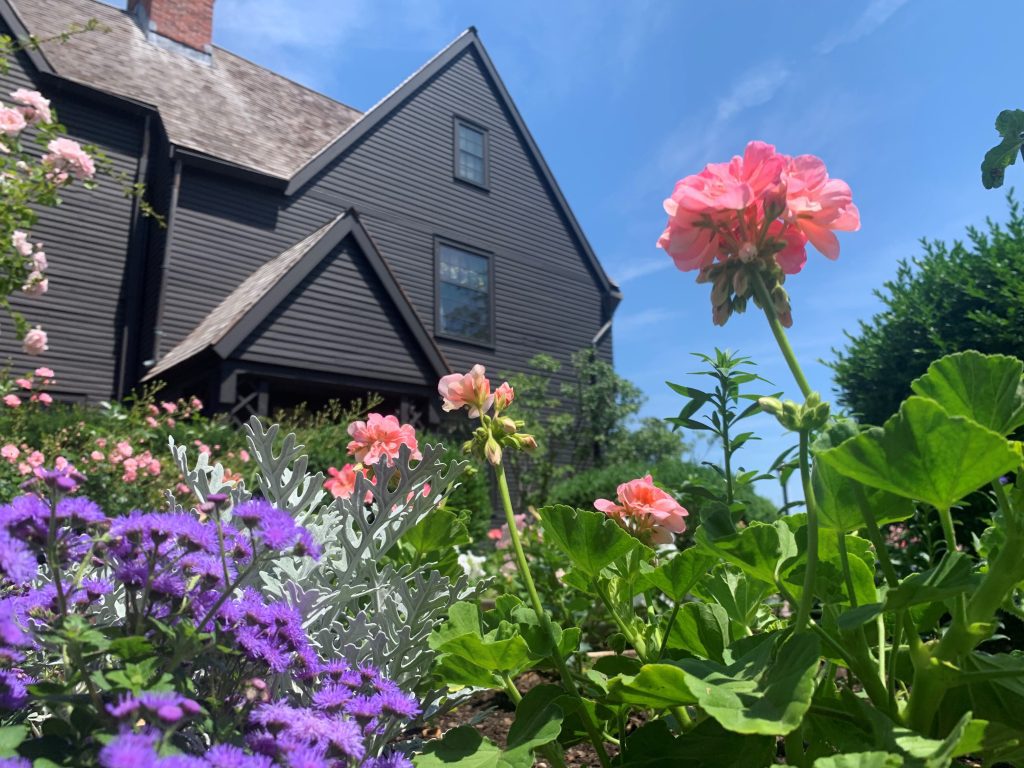
Florals at The Gables
by Anna Ruane
Spring has sprung, and The Gables’ garden is in full bloom. While you’re visiting our site, you may notice that the garden is not the only place where flowers can be seen. Floral imagery has been used as decoration for centuries. From painted ceramics to embossed metals, the natural beauty of flowers has been used to symbolize the feelings, morals, and values of an era. Can you guess the objects in The House of the Seven Gables that the florals below appear on?
“There were also a few species of antique and hereditary flower, in no very flourishing condition, but scrupulously weeded; as if some person, either out of love or curiosity, had been anxious to bring them to such perfection as they were capable of attaining” – Nathaniel Hawthorne, The House of the Seven Gables.

Mystery Image #1

Answer #1: Sophia Peabody Hawthorne’s “Flight Into Egypt”
Circa 1836. Origin: American. Material: Oil on Canvas. Location in Mansion: Parlor.
A framed, European-style landscape inspired by Claude Lorain’s “Flight Into Egypt” (1647). This original work was painted by Sophia Peabody Hawthorne (1809-1871) in 1836. Sophia is considered one of America’s first female commercial artists. In 1842, she married Nathaniel Hawthorne. Sophia would go on to illustrate several short stories and novels of Hawthorne’s, including the second edition of his work, The Grandfather’s Chair.

Mystery Image #2

Answer #2: Wooden Jointed Dolls
Circa 20th Century. Origin: American (Salem or Marblehead). Material: Wood, fabric, paint. Location in Mansion: Cent Shop.
A hand-painted and hand-carved wooden jointed doll. The doll has blue eyes, pink lips and blush, and black hair shaped into curls along the side of the head. The blue floral dress the doll is wearing has an applied paper price tag. These dolls were made to be sold in the gift shop which was originally located in the cent shop of the Turner-Ingersoll mansion. In The House of the Seven Gables novel, Hepzibah sells Dutch wooden dolls as toys in her cent shop.

Mystery Image #3
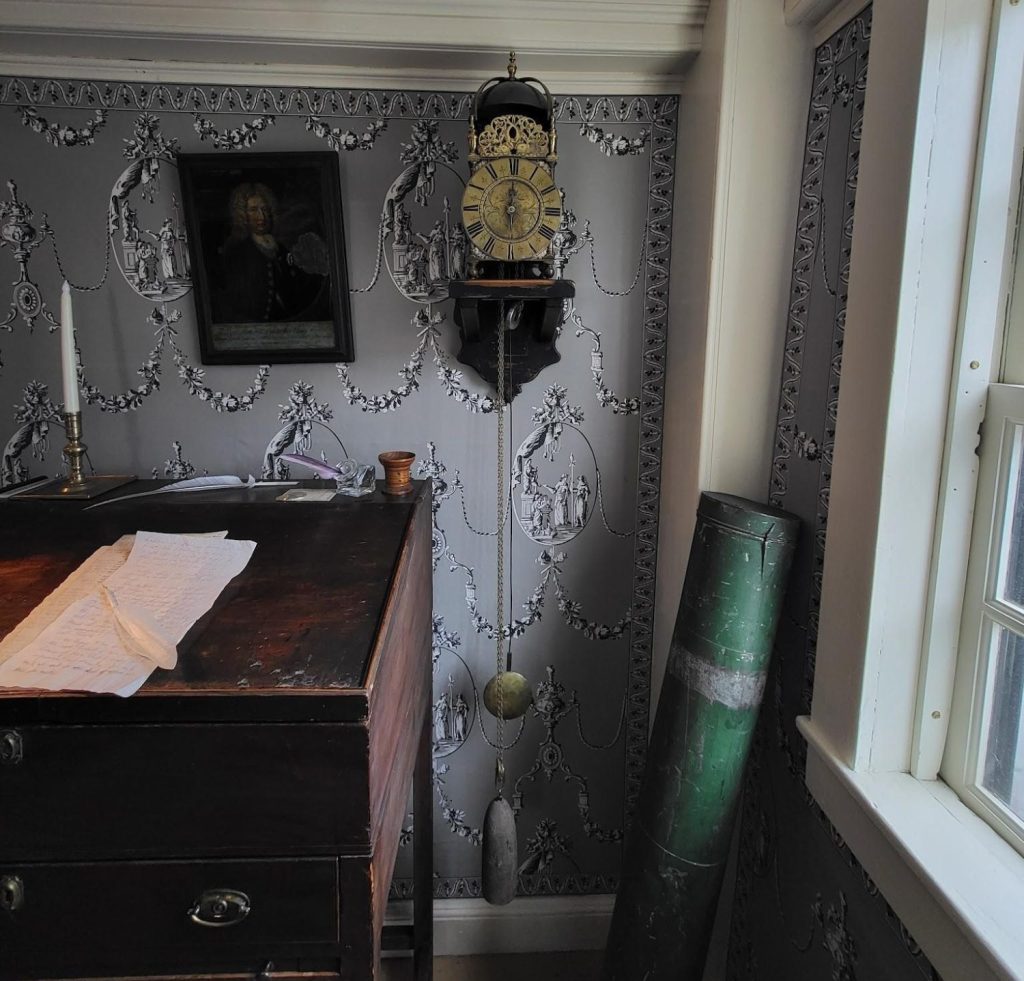
Answer #3: Lantern Clock
Circa 1680. Origin: English. Material: Brass. Location in Mansion: Accounting Room.
An English, brass one-hand lantern clock. Double dolphins are engraved on the front crest. The brass clock face is engraved with floral patterns. The clock has a long pendulum and donut counterweight. It has been fitted with a wooden wall hanging shelf.

Mystery Image #4

Answer #4: Sewing Table
Circa: 1820. Origin: Chinese. Material: Asian softwood, Asian lacquer, gold powders and leaf , ivory or bone, metal. Location in Mansion: Parlor.
A Chinese export sewing table. The surface is decorated with gilt designs on a black lacquer surface. The interior tray has assorted carved ivory sewing implements. The lyre-shaped legs have a fleur-de-lis in the center and are supported by carved paw feet. The gilt designs feature seated figures and floral designs.

Mystery Image #5

Answer #5: Brass detail on pianoforte
Circa 1820. Origin: American (Boston). Material: Mahogany, Rosewood Veneer, Ebony and Ivory Keys, Possible Maple Secondary. Location in Gables: Parlor.
A pianoforte once owned by the Hawthorne family. The mahogany rosewood case is square at the back with rounded front corners. The hinged cover lifts to reveal a hinged music rest. The keyboard has forty ivory keys and twenty-eight ebony keys. Above the keyboard is an engraved brass label “MADE BY A[lpheus] BABCOCK FOR G.D.McKAY, BOSTON.” The piano is supported by six tapering legs with brass casters. The brass casters feature a repeating floral pattern. The interior has a collapsible music stand.

Mystery Image #6

Answer #6: Bottles with Stoppers
Circa: 1850. Origin: English. Material: Porcelain. Location in Mansion: Great Chamber.
A pair of English bottles, possibly Staffordshire, with matching porcelain lids. The body is square cut and features cobalt decorations with gilt and floral highlights.

Mystery Image #7

Answer #7: Cast Iron Fireback
Circa: 1700. Origin: English. Material: Cast Iron. Location in Mansion: Parlor.
An early eighteenth century cast iron fireback, probably English. The fireback is tombstone-shaped with an arched crest. There is an embossed banner along with top crest with the lettering “AN~APE~WILL~NEVER~BE~A~MAN.” The center embossed image depicts a full length caricature of a man who is facing the left. He has long hair and holds a cane in each hand. He is wearing a large hat featuring a Maltese cross, an oversized lace collar, button coat, and knickers. Along the right-hand side is a flowering vine. The image is based on a drawing from an emblem by the English poet and satirist George Wither (1588-1667). In 1634, a book of his short sayings was published and included the line “Though endeavor all he can, an ape will never be a man.”

Mystery Image #8

Answer #8: Tea Box
Circa 19th Century. Origin: Chinese. Material: Wood, Gold, Lacquer. Location in Mansion: Great Chamber.
A nineteenth century Chinese gold lacquered tea box with black decorations. The wooden box has an octagonal base with rounded corners. The front central image depicts two couples. The lid features two butterflies on each side with repeated floral blossoms surrounding it. The interior of the lid is painted red. The base interior is natural wood.